Category: Ocean transport
-

The 10th Copernicus Ocean State Report is now available!
Published annually by the Copernicus Marine Service, the Ocean State Report provides a comprehensive assessment of the state of the global ocean based on satellite observations, in situ measurements, and ocean reanalysis data.This year’s edition highlights how ocean science is essential for understanding ongoing changes in the ocean, their impacts…
-

Iceland-Faroe overflow revealed by in situ observations
New observations reveal where a key branch of AMOC crosses the Iceland-Faroe Ridge How does cold, dense deep-water return southward as part of the Atlantic Meridional Overturning Circulation (AMOC)? Despite decades of research, the exact pathways across the Iceland–Faroe Ridge have remained uncertain. A new study by researchers from Faroe…
-

Tracking a key AMOC pathway: new publication
Tracking a key AMOC pathway: how Atlantic water is transformed before reaching the Arctic The Atlantic inflow across the Iceland–Faroe Ridge carries almost half of the warm Atlantic water entering the Nordic Seas and Arctic Ocean, making it a key component of the climate system and the Atlantic Meridional Overturning…
-
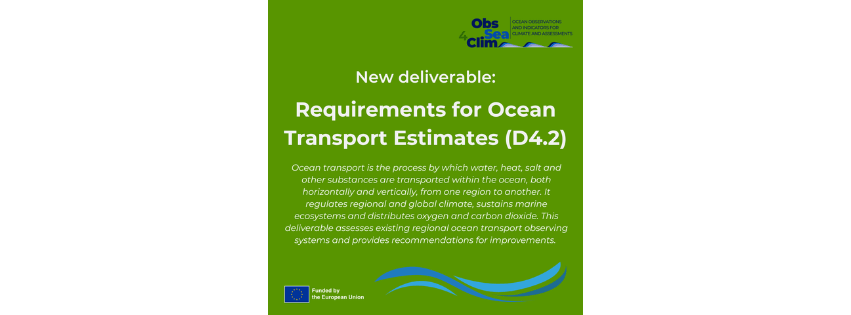
Ocean Transport Estimates
New deliverable: Requirements for Ocean Transport Estimates! Ocean transport is the process by which water, heat, salt and other substances are transported within the ocean, both horizontally and vertically, from one region to another. It regulates regional and global climate by transporting heat from lower to higher latitudes; it sustains…
-
Spotlight: Ocean Transport
Watch the Spotlight on Ocean transport featuring Karin Magretha H. Larsen from the Faroe Marine Research Institute and ObsSea4Clim! In this video Karin Magretha H. Larsen explains:🔹 What ocean transport is🔹 Why ocean transport matters for climate and ecosystems🔹The key scientific challenges related to ocean transport🔹How ObsSea4Clim is advancing observations…
-

Spotlight on Ocean Transport
What is Spotlight? ObsSea4Clim Spotlight is a series of infosheets designed to provide a quick overview of scientific themes addressed in the project. Each document breaks down a key science theme – why it matters, the challenges scientists are tackling, and what ObsSea4Clim is doing about it. Alongside the background,…
-

Characterizing the Interannual Variability of North Atlantic Subpolar Overturning
A new study supported by OSNAP, ObsSea4Clim and EuroSea has been recently published. The Atlantic Meridional Overturning Circulation (AMOC) is important for the global climate due to its role in redistributing heat, freshwater, and dissolved gases over broad spatial scales. Through continuous observations, we now have an 8-year (2014–2022) time…
-

New study on overflow water transport
A new study supported by OSNAP, ObsSea4Clim and EuroSea has been published in the Journal of Physical Oceanography. A mooring array has been maintained across the west Greenland shelf and slope since 2014 as part of the Overturning in the Subpolar North Atlantic Program (OSNAP). Here we use the first…
-

New publication exploring the overflow of water through Faroe Bank Channel into AMOC
The overflow of cold and dense water through the depths of the Faroe Bank Channel is the densest contribution to the Atlantic Meridional Overturning Circulation (AMOC). A recent study led by ObsSea4Clim researcher Karin Margretha Húsgarð Larsen and published in Geophysical Research Letters, sets out to better understand this overflow…

