Category: Publications and deliverables
-
New research on dispersion monitoring in the Mediterranean
Over 2,000 oil spills were recorded in the Mediterranean between 2015 and 2017. How can operational monitoring and forecasting be improved to limit the environmental damage they cause? A new study addresses this challenge by testing a comprehensive framework for predicting how oil spills move and evolve in the Mediterranean…
-

Observed large-scale and deep-reaching compound ocean state changes
A newly published article in Nature Climate Change offers one of the most comprehensive assessments to date of how multiple climate-related stressors are reshaping the ocean. Over the last six decades, the ocean has been undergoing not just one, but multiple simultaneous climate-driven changes. Warming, acidification, deoxygenation, and shifting salinity…
-

New publication on Global Ocean Indicators
We all depend on the ocean – it regulates our climate, supports livelihoods, and sustains life across the planet. Yet the ocean is under strain from climate change, pollution, and biodiversity loss, pushing it beyond safe limits. Ocean indicators turn complex science into clear, actionable insights, helping policymakers, practitioners, and…
-

Characteristics of Mesoscale-to-Submesoscale Eddies in the Labrador Sea
A new study supported by ObsSea4Clim and EuroGO-SHIP has been published in the Journal of Physical Oceanography focuses on describing mesoscale eddies in the Labrador Sea based on ship observations. The characterization of coherent eddies is often based on gridded satellite altimetry products. In subpolar regions, these products face limitations…
-

Characterizing the Interannual Variability of North Atlantic Subpolar Overturning
A new study supported by OSNAP, ObsSea4Clim and EuroSea has been recently published. The Atlantic Meridional Overturning Circulation (AMOC) is important for the global climate due to its role in redistributing heat, freshwater, and dissolved gases over broad spatial scales. Through continuous observations, we now have an 8-year (2014–2022) time…
-

Northern North Atlantic climate variability controls on ocean carbon sinks in EC-Earth3-CC
A new study supported by ObsSea4Clim and the SDU’s climate cluster focuses on describing the climate variability controls on ocean carbon sinks in the EC-Earth3-CC. The northern North Atlantic (NA) is an important net sink of atmospheric CO2, though atmosphere–ocean CO2 fluxes exhibit substantial variability across different timescales. The underlying drivers of this…
-

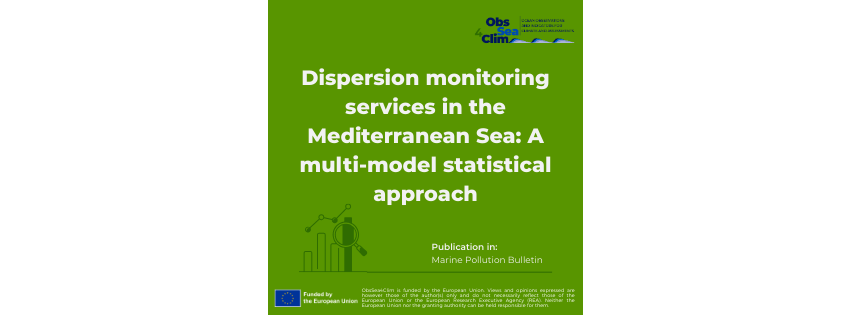
Dispersion monitoring services in the Mediterranean Sea: A multi-model statistical approach
A new study supported by ObsSea4Clim provides a multi-model statistical approach to the dispersion monitoring services in the Mediterranean. Highlights Multi-model framework to assess pollutant dispersion in the Mediterranean Sea. Model choice affects the simulated oil slick paths in the Mediterranean Sea. Including Stokes drift and wind drag improves the…
-

Surface and Subsurface Biogeochemical Impacts of the 2019 Northeast Pacific Marine Heatwave
A new study supported by ObsSea4Clim provides a multi-model statistical approach to the dispersion monitoring services in the Mediterranean. There is growing concern about the impacts of short-term extreme conditions in the ocean, including marine heatwaves. In the summer of 2019, a marine heatwave occurred in the Northeast Pacific, similar…
-

Tracking marine heatwaves in the Balearic Sea
A new study supported by ObsSea4Clim and published in Ocean Science focuses on tracking marine heatwaves in the Balearic Sea, with insights on temperature trends and the role of detection methods. Significant efforts have been directed towards developing new ways of defining marine heatwaves, motivated by the need to differentiate…
-

New study on overflow water transport
A new study supported by OSNAP, ObsSea4Clim and EuroSea has been published in the Journal of Physical Oceanography. A mooring array has been maintained across the west Greenland shelf and slope since 2014 as part of the Overturning in the Subpolar North Atlantic Program (OSNAP). Here we use the first…

