ObsSea4Clim is a project funded by the European Commission and address gaps in ocean observations necessary for robust climate assessment and actionable decision making, operating at the high-level nexus of global ocean observation, climate assessment and EU policy and instruments (European Green Deal, Horizon Europe Missions). The project supports policy in implementing efficient ocean monitoring, assessment, and projections related to climate change, impacts, mitigation, and adaptation potential by closing research gaps on Essential Ocean Variables (EOVs), with a focus on physical oceanic processes. The project activities support adaptation and resilience of natural and managed ecosystems in the context of a changing climate and biodiversity loss.
For whom is this page?
This page is addressed to policymakers and decision-makers operating at international, European, and national levels who work on global scientific climate and biodiversity assessments, such as the IPCC, IPBES, and WOA, as well as on the UNFCCC Ocean and Climate Change Dialogue, the UN Decade of Ocean Science, and the UN SDGs 13 and 14. More specifically, this page addresses:
- Staff working for international organisations such as GCOS, WMO, GOOS, SAON, AMAP and IPBES (the list is not exhaustive).
- Staff working for the European Commission, the European Parliament or other European institutions, including the European Space Agency, the European Environmental Agency and the Joint Research Centre of the European Commission.
- Staff working at the member state level for governmental institutions.
Which resources are made available on this page?
On this page, you will find valuable resources and scientific evidence for supporting you in the shaping of strategies, reports and decisions. Specifically, resources for improving the monitoring, understanding, reporting (Essential Ocean and Climate Variables) and projections of key physical oceanic processes related to climate and ocean changes over time. The project focuses on the production of related Essential Ocean Variables and advancing the framework of Ocean Indicators at regional or sea basin scale. Work and exploration narratives is organized around key ocean-climate application areas including ocean transports, marine heatwaves, the ocean mesoscale, ocean stratification and sea ice.
These resources are included and refer to relevant publications, contributions to global reports and assessments, and dedicated policy briefs, which are planned for June 2026 and September 2027.
Policy insight 1: Challenges and opportunities for a more integrated ocean observing
To be able to deliver ocean forecasts and early warnings, climate projections and assessments and to protect ocean health and its benefits, it is vital that the ocean observing system can deliver on Essential Ocean Variables (EOVs) and Essential Climate Variables (ECVs). EOVs and ECVs form the basis of the Global Climate Indicators, which contain key information on the most relevant areas of climate change. The physics, chemistry, biology and biodiversity (including microbes and macro-organisms) of the ocean system are irrevocably interlinked. Nevertheless, several challenges must be addressed in implementing an integrated ocean observing system:
- Technical: Technical terminology and acronyms associated with EOVs vary across disciplines, making cross-disciplinary communication and understanding more difficult.
- Knowledge: There remains uncertainty about how certain physical EOVs, such as ocean pressure, affect biological processes.
- Discipline silos: EOVs are often developed in isolation, making it challenging to build cohesive, comprehensive ocean observation models.
- Measurements: Certain biological EOVs, such as biomass and macroalgal cover, are particularly challenging to measure, and integrating their data with physical parameters like temperature and currents remains complex.
- Scale: The spatial and temporal scales at which physical and biological variables are measured do not always align, making integration difficult and sometimes leading to inconsistencies across datasets.
ObsSea4Clim, together with two projects, BioEcoOcean, and BioGeoSea, collaborate and exchange knowledge towards creating a more integrated and fit-for-purpose ocean observing system. ObsSea4Clim focuses on physical oceanic processes, BioGeoSea on biogeochemical processes, and BioEcoOcean on biological and ecosystem oceanic processes. Together, we are exploring solutions for a more integrated ocean observing system:
- Developing integrated models and data products: By linking biological and physical data—such as phytoplankton biomass with SST, currents, and sea ice cover—scientists can create cross-field data products that reduce uncertainties in ocean observations. Moreover, combining satellite data with in-situ sensor observations can help address scale mismatches between biological and physical data, supported by statistical modelling approaches.
- Leveraging AI tools: Artificial intelligence can streamline data analysis and integration, enabling more accurate predictions and deeper insights into ocean dynamics.
- Broadening expert involvement: Expanding the pool of EOV experts who contribute to refining EOV specifications and incorporating additional sub-variables could ensure more comprehensive coverage of oceanic processes.
- Encouraging interdisciplinary research: More studies and model developments are needed to explore how variables like ocean pressure influence biological EOVs.
Resources available
Milestone 8 Workshop across the EOV projects summarizing further discussions across the EOV Network projects: https://zenodo.org/records/16598195
Deliverable D6.1 Clustering Event Nr. 1 providing a full report from the meeting between ObsSea4Clim and BioEcoOcean: https://zenodo.org/records/15304180
Source: von Schuckmann et al. (2025)
Policy insight 2: Global ocean indicators provide actionable insights for risk mitigation
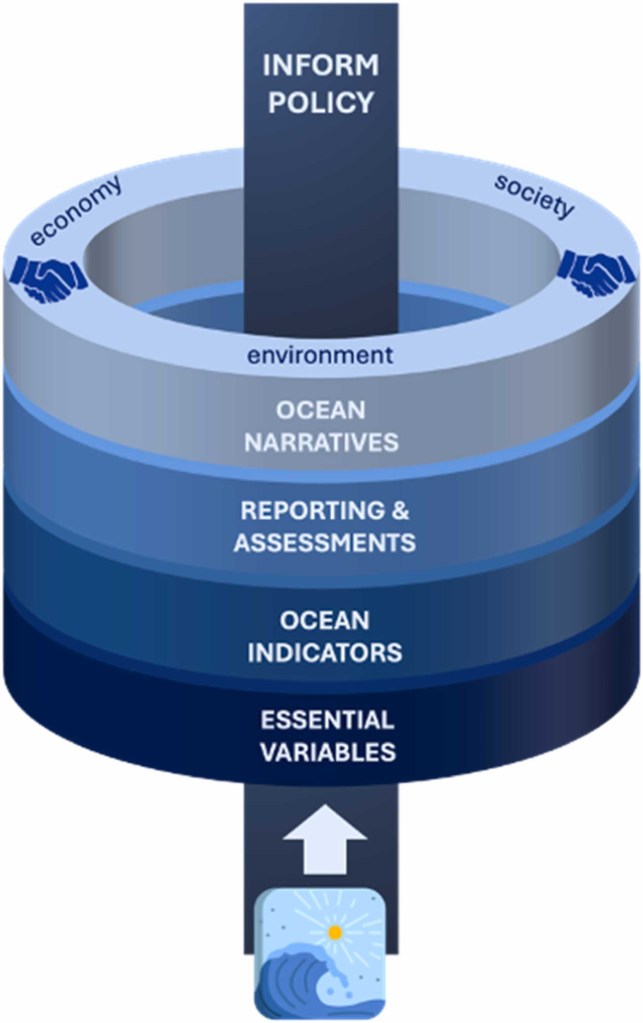
Ocean knowledge is crucial for shaping policies that enable sustainable development, adaptation, and well-being at all levels, as everyone – either directly or indirectly – depends on the ocean, which today faces escalating threats from climate change, pollution, and biodiversity loss, pushing us towards or beyond critical planetary boundaries. Ocean Indicators are crucial for translating ocean science and data into practical metrics, guidance, and tools that inform policymakers, practitioners, and the public on the state and health of the ocean. For instance, Ocean Indicators support effective adaptation planning and can strengthen associated decision-making capacity for local communities, such as for sea level, sea ice, ocean warming, ocean acidification, or ocean deoxygenation.
Despite their critical importance, Ocean Indicators trail behind those for continental areas, limiting effective monitoring and policy integration. Developing reliable, comparable, and regularly updated ocean indicators, backed by a unified international framework, is essential for delivering coherent, actionable insights that can guide global goals and protect the ocean’s future
A recent study, led by Karina Von Schuckmann from ObsSea4Clim and Mercator Ocean International, establishes a structured framework of ocean indicators. This paper demonstrates a scientific foundation for ocean indicators through international and multidisciplinary collaboration, presenting defined criteria and a set of pilot indicators for the ocean’s physical, biogeochemical, and biodiversity aspects, as well as its ecosystems. The proposed framework offers a solid foundation for generating indicators that not only track the ocean state but also provide outputs to inform policy and decision-making. The study is available in Open Access in the Marine Policy Journal: Global ocean indicators: Marking pathways at the science-policy nexus.
Resources available
von Schuckmann, K., Godoy-Faundez, A., Garçon, V., Müller-Karger, F. E., Evans, K., Appeltans, W., … Yu, W. (2025). Global ocean indicators: Marking pathways at the science–policy nexus. Marine Policy, 184, 106922. https://doi.org/10.1016/j.marpol.2025.106922

Policy Insight 3: Ocean change is deeply interconnected with shifts in marine ecosystems, human societies, culture, and the global economy
The 9th edition of the EU Copernicus Ocean State Report (OSR 9) highlights how the ocean has changed over recent decades, with special attention to the extreme events of 2023 and 2024. This year’s report examines how ocean change is deeply interconnected with shifts in marine ecosystems, human societies, culture, and the global economy.
The first chapter on Global ocean change in the era of the triple planetary crisis highlights three messages key to policymaking:
- The ocean is undergoing unprecedented and accelerating change, with direct consequences for climate stability.
- Triple planetary crisis poses a real threat to the ocean, with pollution, biodiversity loss, and climate change putting increasing pressure on marine systems worldwide.
- Protecting the ocean through concerted global cooperation informed by integrated evidence-based and strategic ocean knowledge is essential to ensure the ocean can continue to play its crucial role in sustaining life and regulating Earth’s climate.
More details can be found in Chapter 1 of OSR9.
Resources available
The Ocean State Report, 9th edition (2025) is produced annually through a large international scientific collaboration involving more than 100 experts from Europe and around the world. It is compiled by the Copernicus Marine Service.
Full report: 9th edition of the Copernicus Ocean State Report (OSR9)
Chapter 1: Global ocean change in the era of the triple planetary crisis. The first chapter of OSR 9 has been co-authored by ObsSea4Clim partners, Karina von Schuckmann and Aurélien Liné (Mercator Ocean International).
Summary for policy makers: OSR 9 summary
Policy Insight 4: Advancing ocean knowledge for the EU Ocean Pact
ObsSea4Clim supports the EU Ocean Pact by strengthening the scientific foundation needed for effective, evidence-based ocean and climate policy. By improving the quality, accessibility, and policy relevance of ocean observations, the project helps translate complex data into actionable insights for decision-makers.
Key results contributing to EU Ocean Pact:
- Closing critical data gaps for informed decisions
New data density maps and uncertainty assessments for Essential Ocean Variables (EOVs) developed in ObsSea4Clim highlight where observations are lacking and improve data reliability, enabling more confident policy and investment decisions. Resource: Essential Ocean Variables’ Reliability, Accuracy, and Uncertainty Maps (D2.1) - Harmonised definition of ocean indicators for policy use
A harmonised definition of ocean indicators, supported by clear quality criteria (verified, significant, scalable, justified, measurable, accessible), ensures consistency and credibility in tracking ocean and climate change. Resource: Schuckmann et al. 2026. - Contextualising ocean data through policy-relevant narratives
The “ocean narratives” approach links scientific indicators to key policy challenges, supporting integrated, cross-sectoral decision-making. Resource: Chapter 1 of the Ocean State Report (2025). - Regional insights for targeted policy action
Development of regionalised indicators improves understanding of how different European sea basins respond to climate change, enabling more precise and locally adapted policy measures. Resource: Leveraging the need for indicators: An Outline Report (D3.4) - Better identification of climate risks and extremes
A new framework for defining marine extremes (e.g. heatwaves, sea level events, sea ice changes) strengthens risk assessments and supports climate adaptation and mitigation planning. Resource: Identification of Extreme Indicators for Task 3.2 “Marine extremes in Europe and the Arctic area” (MS5) - Improved access to best practices and standards
The Ocean Practices Federated Network (OPFN) creates a single entry point to validated methods, enhancing interoperability and efficiency across European ocean observing systems. Resource: Preliminary Design of a Federated Network for Methodologies in Ocean Observing (MS17) - Enhanced coordination across ocean observation domains
The EOV Network connects EU projects across physical, biogeochemical, and ecosystem observations, supporting a more integrated and cost-effective approach to ocean monitoring. Resource: A European EOV/ECVs network promoting multidisciplinary observing (MS4)

Upcoming policy resources: policy briefs in July 2026 and October 2027
During the project, ObsSea4Clim will deliver two policy briefings.
The topics will be announced at the appropriate time. If you are interested in joining these events and contributing to the briefings, please get in touch with the coordination team and subscribe to ObsSea4Clim on LinkedIn.
 ObsSea4Clim