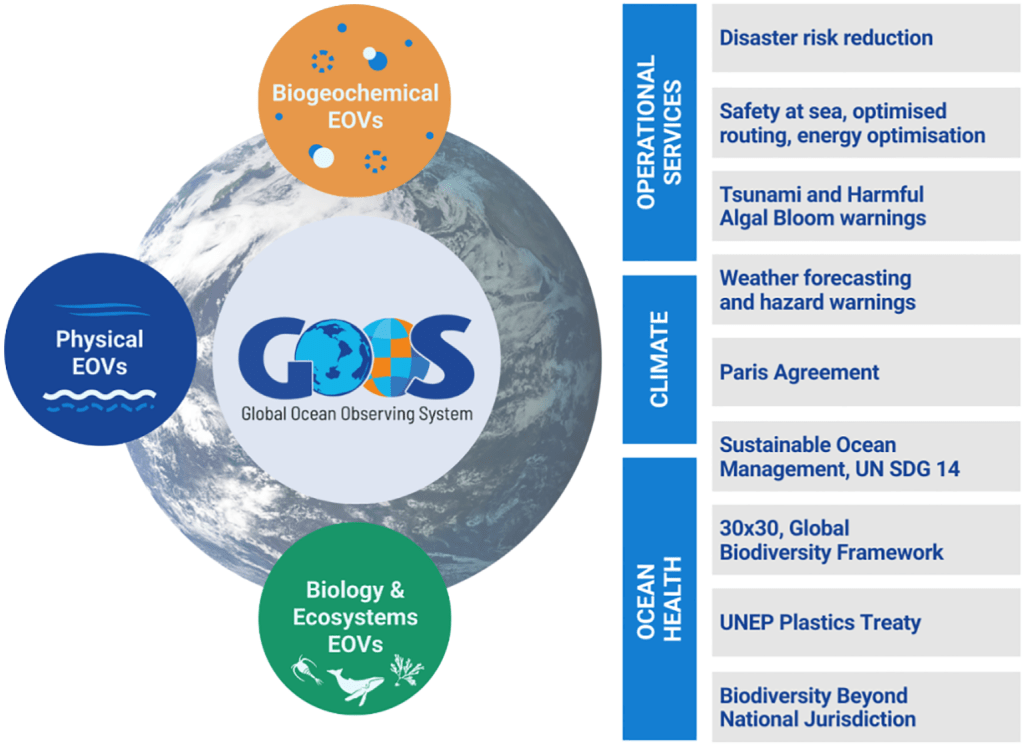
Sustained collection of ocean observations spanning ocean physics, biogeochemistry, and biology and ecosystems, is crucial for more nuanced understanding of the ocean and climate change. Global Ocean Observing System (GOOS) coordinates efforts to collect these Essential Ocean Variables (EOVs), which in turn contribute to a number of policy frameworks, national and international action plans, and multilateral agreements (see fig. below).
A new publication in Frontiers in Marine Science provides a comprehensive description of the EOV framework, discusses the challenges to its implementation, and provides actionable recommendations to GOOS on how to take it forward.
Recommendations include:
▫️ Increasing the transparency of the EOV adoption process
▫️ Periodical assessment of EOVs in consultation with observing communities
▫️ Dialogue and coordination with entities managing other global essential variable frameworks (e.g., in climate or biodiversity)
🔗 Full article available here: https://doi.org/10.3389/fmars.2026.1737002
Cite as: Martín Míguez, B., Heslop, E., Bax, N., Benedetti-Cecchi, L., Canonico, G., Currie, K., Evans, K., Fischer, A. S., Garçon, V., Hood, M., Karstensen, J., Lara-López, A., Legler, D., Muller-Karger, F. E., Nair Thayannur Mullachery, B., Nordlund, L. M., Palacz, A. P., Post, J., Simmons, S. E., … Yu, W. (2026). GOOS essential ocean variables: The backbone of a sustained and evolving global ocean observing system. Frontiers in Marine Science, 13, Article 1737002. https://doi.org/10.3389/fmars.2026.1737002
 ObsSea4Clim