A newly published article in Nature Climate Change offers one of the most comprehensive assessments to date of how multiple climate-related stressors are reshaping the ocean.
Over the last six decades, the ocean has been undergoing not just one, but multiple simultaneous climate-driven changes. Warming, acidification, deoxygenation, and shifting salinity patterns are interacting in ways that reshape ocean conditions from the surface all the way to the deep ocean. Using a time-of-emergence approach applied across a suite of physical and biogeochemical observations, the study shows that compound climate impact-drivers are now emerging across vast regions, including the subtropical/tropical Atlantic, subtropical Pacific, Arabian Sea, and the Mediterranean.
𝗞𝗲𝘆 𝗳𝗶𝗻𝗱𝗶𝗻𝗴𝘀:
🔹 Changes are deep-reaching, affecting multiple ocean layers – not just the surface.
🔹 Compound signals are persistent and strong, indicating that new climate-driven baselines are forming.
🔹 Marine ecosystems, fisheries, and coastal communities increasingly face multiple interacting stressors, not isolated trends.
𝗪𝗵𝘆 𝗶𝘁 𝗺𝗮𝘁𝘁𝗲𝗿𝘀:
This work strengthens the scientific basis for integrated ocean–climate policy. It underscores the need to:
🔹 Move beyond single-stressor frameworks in climate adaptation and marine management.
🔹 Design monitoring and early-warning systems that detect compound changes, not just isolated trends.
🔹 Support international cooperation for ocean observation, especially in regions where climate-driven shifts are accelerating.
🔗 Read the full article: https://www.nature.com/articles/s41558-025-02484-x
Cite as: Tan, Z., von Schuckmann, K., Speich, S. et al. Observed large-scale and deep-reaching compound ocean state changes over the past 60 years. Nat. Clim. Chang. (2025). https://doi.org/10.1038/s41558-025-02484-x
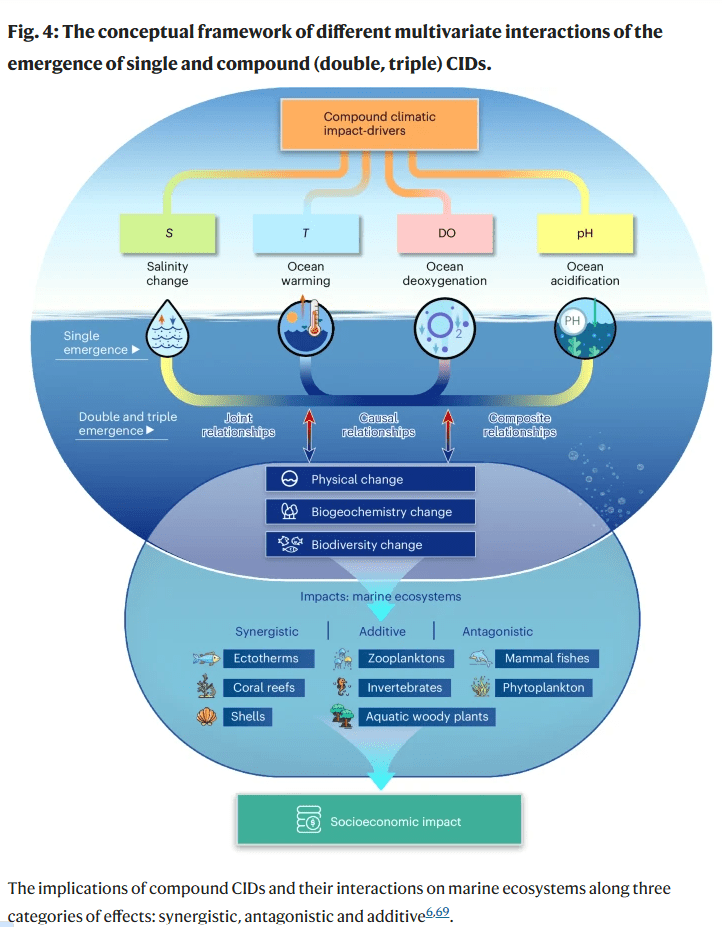
Figure: The conceptual framework of different multivariate interactions of the emergence of single and compound (double, triple) CIDs. (Source: article)
 ObsSea4Clim