
This article has been originally posted on ObsSea4Clim LinkedIn channel as a summary of key insights from the Clustering Event I with BioEcoOcean project.
The Clustering Event I took place on 11-12 March 2025 at the Institute of Oceanology, Polish Academy of Sciences (IOPAN) and gather project participants from both ObsSea4Clim and BioEcoOcean, and featured an introduction from the third sister project, BioGeoSea.
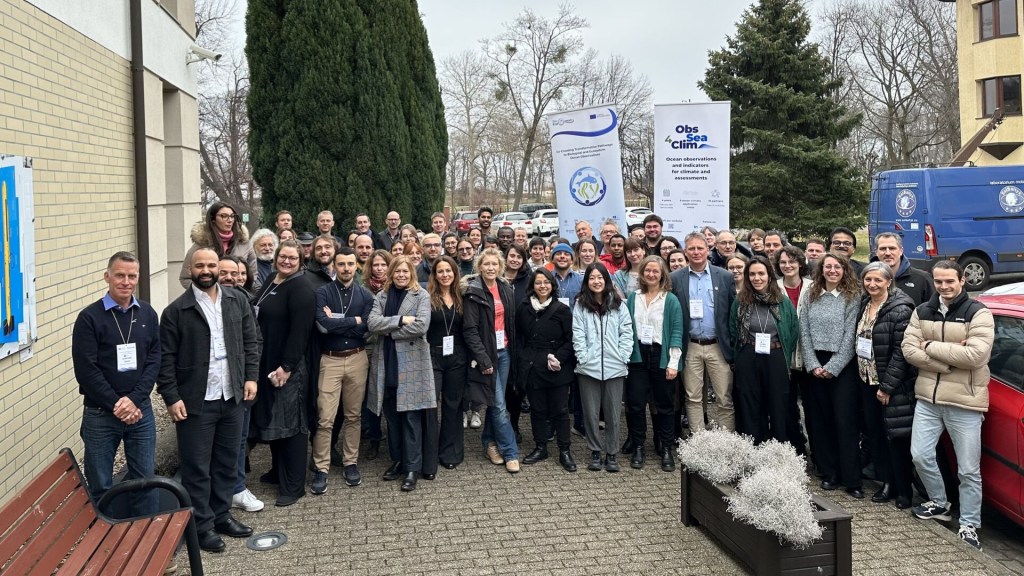
The global movement towards an integrated and unified ocean observing system is gaining momentum. However, achieving this vision is not without its challenges. While physical, biological, and biogeochemical ocean observations are all crucial to understanding our oceans, significant differences exist in how they are conducted, interpreted, and integrated. Addressing these differences was the key focus of a recent Clustering Event held in Sopot, Poland, where the two projects—ObsSea4Clim (focused on physical ocean observing) and BioEcoOcean (focused on biological-ecological ocean observing)—came together to share knowledge and identify opportunities for closer collaboration.
The event was structured into three thematic sessions:
- Essential Ocean Variables (EOVs)
- Land, Coast, and Ocean Interactions
- Marine Heatwaves
These discussions were followed by a workshop focused on policy relevance and recommendations, to ensure that the projects will have broader societal and policy impacts.
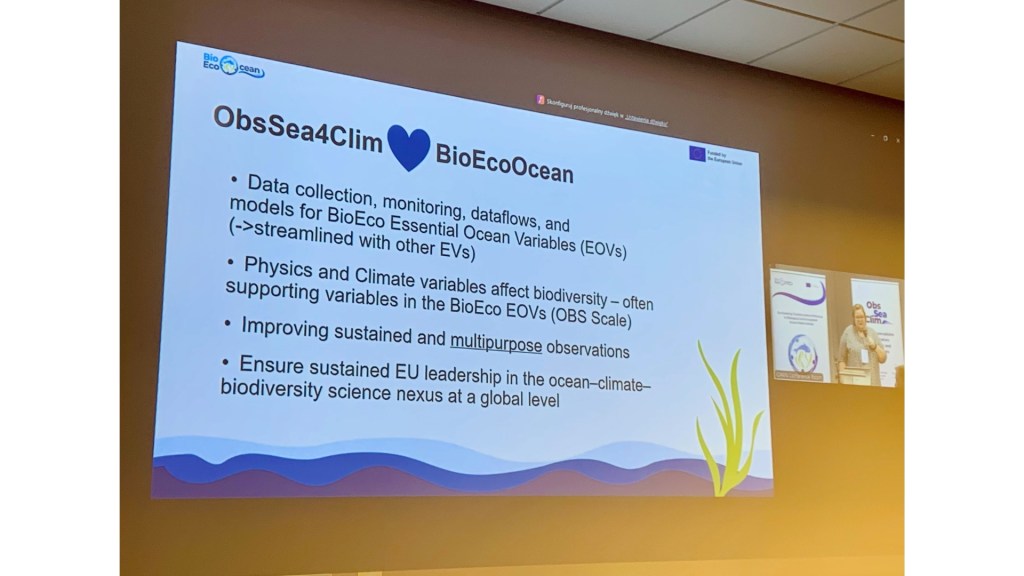
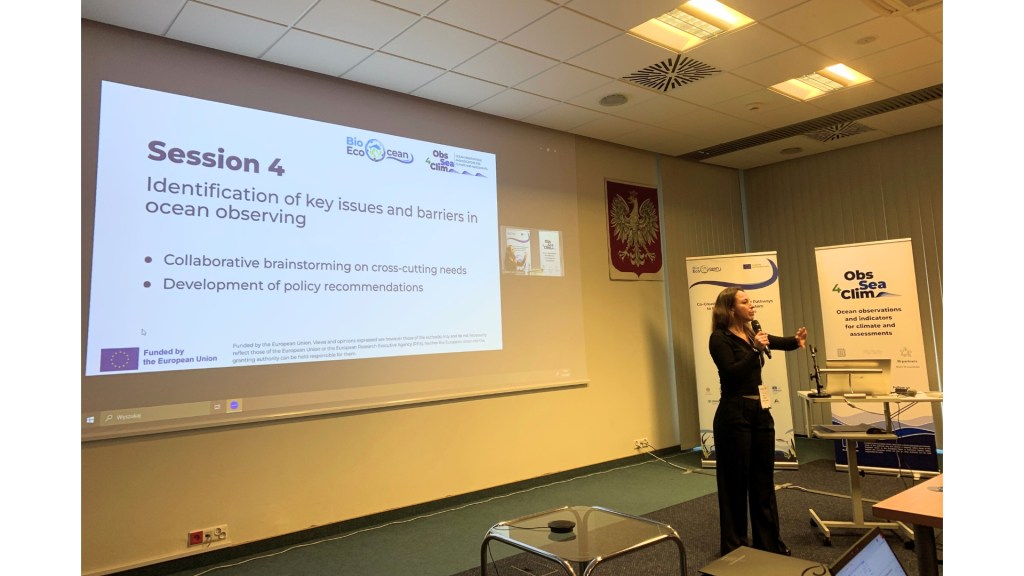
Lina Mtwana Nordlund, BioEcoOcean. Photo: Justyna Bekier, DMI.
Recognizing the Interconnectedness of Essential Ocean Variables
One of the major discussions revolved around the connections and interdependencies between biological and physical EOVs. Many EOV relationships were identified, including but not limited to:
- Sea surface temperature (SST) and ocean color are directly linked to phytoplankton biomass, illustrating the need for cross-disciplinary approaches in ocean monitoring.
- Subsurface temperature emerged as a key connecting factor, influencing numerous biological variables, including phytoplankton biomass, species composition, fish abundance, and benthic invertebrate distribution.
- A truly holistic ocean observing system should account for how living habitats influence physical parameters like ocean currents and temperature.
Overall, participants highlighted the need for deeper integration of biological, ecosystem, and physical EOVs to enhance ocean observation accuracy and improve climate models.

Challenges in Ocean Observing Across Disciplines
Despite the clear interconnections between variables, participants acknowledged several challenges:
- Technical barriers: Technical terminology and acronyms associated with EOVs vary across different disciplines, making communication and understanding across disciplines more difficult.
- Knowledge gaps: There is still uncertainty about how some physical EOVs, such as ocean pressure, impact biological processes.
- Discipline silos: EOVs are often developed in isolation, making it difficult to create cohesive and comprehensive ocean observation models.
- Measurement difficulties: Certain biological EOVs, such as biomass and macroalgal cover, are particularly challenging to measure, and integrating their data with physical parameters like temperature and currents remains complex.
- Scale mismatches: The spatial and temporal scales at which physical and biological variables are measured do not always align, making integration difficult and sometimes leading to inconsistencies in datasets.
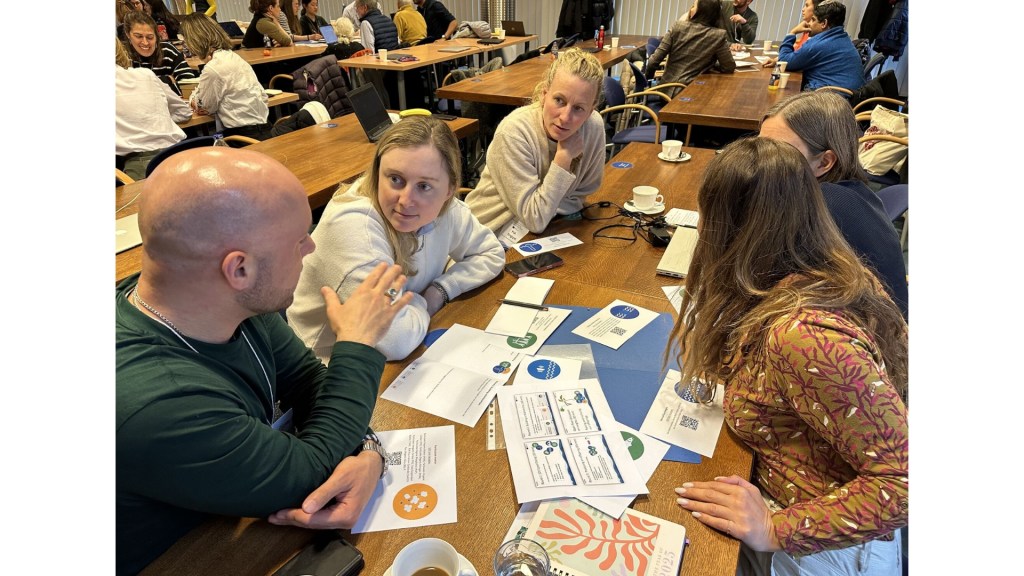
Exploring Solutions for a More Integrated Ocean Observing System
While the challenges are significant, the discussions in Sopot also focused on potential solutions to drive integration and innovation in ocean observing:
- Broadening expert involvement: Expanding the pool of EOV experts who contribute to the refinement of EOV specifications and incorporating additional sub-variables could ensure more comprehensive coverage of oceanic processes.
- Encouraging interdisciplinary research: More studies and model developments are needed to explore how variables like ocean pressure influence biological EOVs.
- Developing integrated models and data products: By linking biological and physical data—such as phytoplankton biomass with SST, currents, and sea ice cover—scientists can create cross-field data products that reduce uncertainties in ocean observations. Moreover, combining satellite data with in-situ sensor observations can help address scale mismatches between biological and physical data, supported by statistical modeling approaches.
- Leveraging AI tools: Artificial intelligence has the potential to streamline data analysis and integration, enabling better predictions and deeper insights into ocean dynamics.
Looking Forward: Towards a More Unified Approach
The Clustering Event in Sopot marked an important step for both projects, and highlighted what issues are necessary for the ocean observing community to tackle together.
As the global community continues to push for an integrated ocean observing system, events like these are crucial in shaping the future of marine research and ensuring that we have the necessary tools to monitor, protect, and sustain our ocean.
At ObsSea4Clim, we look forward to further collaboration with BioEcoOcean and the ocean observing community.
Curious to learn more? Follow the two projects here:
ObsSea4Clim:
Website: https://obssea4clim.eu/
LinkedIn: https://www.linkedin.com/company/obssea4clim/
BlueSky: https://bsky.app/profile/obssea4clim.bsky.social
BioEcoOcean:
Website: https://bioecoocean.org/
LinkedIn: https://www.linkedin.com/company/bioecoocean/
BlueSky: https://bsky.app/profile/bioecoocean.bsky.social
The ObsSea4Clim and BioEcoOcean projects have received funding from the European Union’s Horizon Europe research and innovation programme under grant agreements [No. 101136548] and [No. 101136748].
This document reflects only the authors’ views, and the European Commission is not responsible for any use that may be made of the information it contains.
 ObsSea4Clim